
This post will be about the quiz solution for chapter 5 of Fin 527 course (Financial Management- Theory & Practice). It is accessible through cengage.
The table of contents are below:
Question 1 (Bond Valuation with Annual Payments)
| Jackson Corporation’s bonds have 12 years remaining to maturity. Interest is paid annually, the bonds have a $1,000 par value, and the coupon interest rate is 9%. The bonds have a yield to maturity of 10%. What is the current market price of these bonds? Do not round intermediate calculations. Round your answer to the nearest cent. |

With your financial calculator, enter the following:
N = 12; I/YR = YTM = 10%; PMT = 0.09 × 1,000 = 90; FV = 1,000; PV = VB = ?
PV = $931.86.
Alternatively,
VB = $90((1 – 1/1.1012 )/0.10) + $1,000(1/1.1012 )
= $931.86.
Question 2 (Yield to Maturity for Annual Payments)
Wilson Corporation’s bonds have 7 years remaining to maturity. Interest is paid annually, the bonds have a $1,000 par value, and the coupon interest rate is 9%. The bonds sell at a price of $1,095. What is their yield to maturity? Round your answer to two decimal places.


Question 3 (Current Yield for Annual Payments)
Heath Food Corporation’s bonds have 19 years remaining to maturity. The bonds have a face value of $1,000 and a yield to maturity of 5%. They pay interest annually and have a 6% coupon rate. What is their current yield? Do not round intermediate calculations. Round your answer to two decimal places.


Question 4 (Determinant of Interest Rates)
The real risk-free rate of interest is 2%. Inflation is expected to be 3% this year and 4% during each of the next 2 years. Assume that the maturity risk premium is zero.
What is the yield on 2-year Treasury securities? Round your answer to two decimal places.
 5.5%
5.5%
What is the yield on 3-year Treasury securities? Round your answer to two decimal places.
5.67%
| Solution |
| r* = 2%; I1 = 3%; I2 = 4%; I3 = 4%; MRP = 0; rT-2 = ?; rT-3 = ?r = r* + IP + DRP + LP + MRPSince these are Treasury securities, DRP = LP = 0.rT-2 = r* + IP2 IP2 = (3% + 4%)/2 = 3.50% rT-2 = 2.00% + 3.50% = 5.50%.rT-3 = r* + IP3 IP3 = (3% + 4% + 4%)/3 = 3.67% rT-3 = 2.00% + 3.67% = 5.67%. |
Question 5 (Default Risk Premium)
A Treasury bond that matures in 10 years has a yield of 6%. A 10-year corporate bond has a yield of 8%. Assume that the liquidity premium on the corporate bond is 0.4%. What is the default risk premium on the corporate bond? Round your answer to one decimal place.
| Solution |
| rT-10 = 6%; rC-10 = 8%; LP = 0.4%; DRP = ? r = r* + IP + DRP + LP + MRP. rT-10 = 6% = r* + IP + MRP; DRP = LP = 0. rC-10 = 8% = r* + IP + DRP + 0.4% + MRP. Because both bonds are 10-year bonds the inflation premium and maturity risk premium on both bonds are equal. The only difference between them is the liquidity and default risk premiums. rC-10 = 8% = r* + IP + MRP + 0.4% + DRP. But we know from above that r* + IP + MRP = 6%; therefore,rC-10 = 8% = 6% + 0.4% + DRP 1.6% = DRP. |
Difference is 2%. Subtract 0.4% from it!
Question 6 (Maturity Risk Premium)
The real risk-free rate is 2%, and inflation is expected to be 2% for the next 2 years. A 2-year Treasury security yields 5.1%. What is the maturity risk premium for the 2-year security? Round your answer to one decimal place.

| Solution |
| r* = 2%; IP = 2%; rT-2 = 5.1%; MRP = ?rT-2 = r* + IP + MRP2 = 5.1% rT-2 = 2% + 2% + MRP = 5.1% MRP = 1.1%. |
Question 7 (Bond Valuation with Semiannual Payments)
Renfro Rentals has issued bonds that have a 9% coupon rate, payable semiannually. The bonds mature in 13 years, have a face value of $1,000, and a yield to maturity of 8.5%. What is the price of the bonds? Round your answer to the nearest cent.
For semi-annual payment, n=2 so adjust rates, time and payment and you are good to go.
| Solution |
| The problem asks you to find the price of a bond, given the following facts:N = 26; I/YR = 8.5/2 = 4.25; PMT = 45; FV = 1,000.With a financial calculator, solve for PV = $1,038.89. |

Question 8 (Yield to Maturity and Call with Semiannual Payments)
Thatcher Corporation’s bonds will mature in 11 years. The bonds have a face value of $1,000 and a 9% coupon rate, paid semiannually. The price of the bonds is $1,050. The bonds are callable in 5 years at a call price of $1,050. What is their yield to maturity? What is their yield to call? Do not round intermediate calculations. Round your answers to two decimal places.
| Solution |
| With your financial calculator, enter the following to find YTM:N = 11 × 2 = 22; PV = -1,050; PMT = 0.09/2 × 1,000 = 45; FV = 1,000; I/YR = YTM = ? YTM = 4.1491% × 2 = 8.30%.With your financial calculator, enter the following to find YTC:N = 5 × 2 = 10; PV = -1,050; PMT = 0.09/2 × 1,000 = 45; FV = 1,050; I/YR = YTC = ? YTC = 4.2857% × 2 = 8.57%. |

Question 9 (Bond Valuation and Interest Rate Risk)
Bond Valuation and Interest Rate Risk
The Garraty Company has two bond issues outstanding. Both bonds pay $100 annual interest plus $1,000 at maturity. Bond L has a maturity of 15 years, and Bond S has a maturity of 1 year.
- What will be the value of each of these bonds when the going rate of interest is 4%? Assume that there is only one more interest payment to be made on Bond S. Do not round intermediate calculations. Round your answers to the nearest cent.Bond L: $ Bond S: $
- What will be the value of each of these bonds when the going rate of interest is 10%? Assume that there is only one more interest payment to be made on Bond S. Do not round intermediate calculations. Round your answers to the nearest cent.Bond L: $ Bond S: $
- What will be the value of each of these bonds when the going rate of interest is 15%? Assume that there is only one more interest payment to be made on Bond S. Do not round intermediate calculations. Round your answers to the nearest cent.Bond L: $ Bond S: $


Solution
| a. | 1. 4%:Bond L:Input N = 15, I/YR = 4, PMT = 100, FV = 1,000, PV = ? PV = $1,667.10. Bond S:Change N = 1, PV = ? PV = $1,057.69.2. 10%:Bond L:From Bond S inputs, change N = 15 and I/YR = 10, PV = ? PV = $1,000.00. Bond S:Change N = 1, PV = ? PV = $1,000.00.3. 15%:Bond L:From Bond S inputs, change N = 15 and I/YR = 15, PV = ? PV = $707.63. Bond S:Change N = 1, PV = ? PV = $956.52. |
| b. | Think about a bond that matures in one month. Its present value is influenced primarily by the maturity value, which will be received in only one month. Even if interest rates double, the price of the bond will still be close to $1,000. A one-year bond’s value would fluctuate more than the one-month bond’s value because of the difference in the timing of receipts. However, its value would still be fairly close to $1,000 even if interest rates doubled. A long-term bond paying semiannual coupons, on the other hand, will be dominated by distant receipts, receipts which are multiplied by 1/(1 + rd/2)t, and if rd increases, these multipliers will decrease significantly. Another way to view this problem is from an opportunity point of view. A one-month bond can be reinvested at the new rate very quickly, and hence the opportunity to invest at this new rate is not lost; however, the long-term bond locks in subnormal returns for a long period of time. Hence, longer-term bonds have more interest rate risk than shorter-term bonds. |
Long term bonds fluctuate more than short term bonds because of Interest rates risks. Interest rate risk is that risk where bond owners are exposed to changes in interest rate scenario. With the increase in period of maturity of the bond the interest rate risk also increases because the chances of bond to fluctuate are even more hence small changes in interest rates compounded for a long period will significantly impact the return for bond holders. In comparison smaller maturity bonds price is not effected greatly with the change in interest rate as compounding period are far less to have any significant impact.
Also the reason that longer-term bonds have greater interest rate sensitivity is that a large portion of the bond’s value comes from the $1,000 face amount. The present value of this amount is not greatly affected by a small change in interest rates if the amount to be received in one year. Even a small change in interest rates, however, once it is compounded for 15 years, can have a significant effect on the present value as mentioned in the earlier paragraph.
Question 10 (Yield to Maturity and Required Returns)
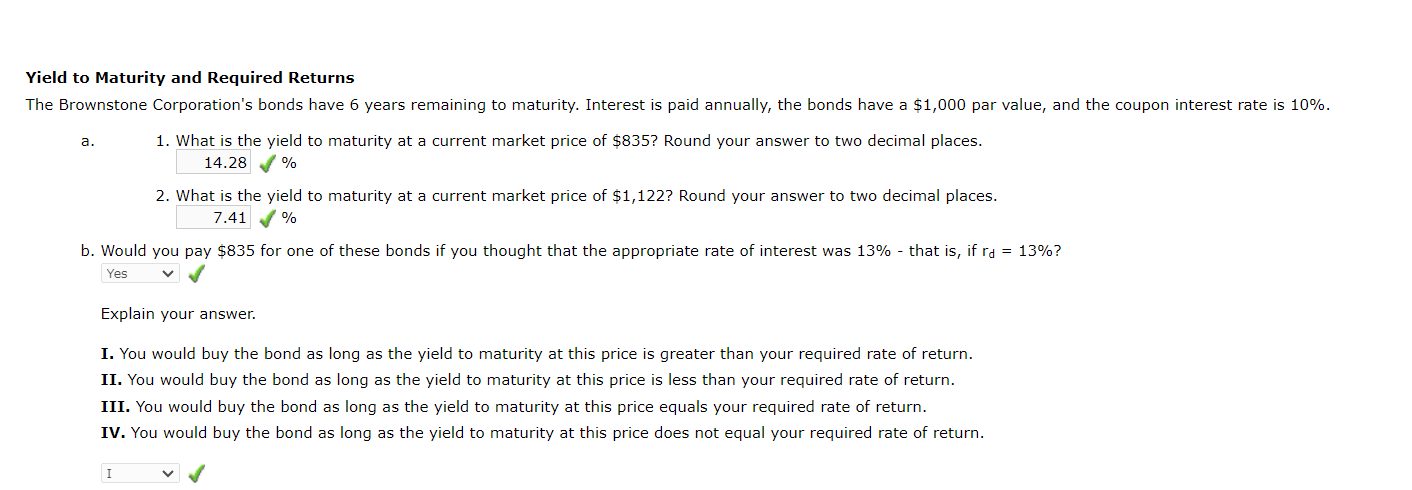
| The Brownstone Corporation’s bonds have 6 years remaining to maturity. Interest is paid annually, the bonds have a $1,000 par value, and the coupon interest rate is 10%.What is the yield to maturity at a current market price of $835? Round your answer to two decimal places. %What is the yield to maturity at a current market price of $1,122? Round your answer to two decimal places. % |

| Solution |
| a.Calculator solution:1.Input N = 6, PV = -835, PMT = 100, FV = 1,000, I/YR = ? I/YR = 14.28%.2.Change PV = -1,122, I/YR = ? I/YR = 7.41%.b.Yes. At a price of $835, the yield to maturity, 14.28 percent, is greater than your required rate of return of 13 percent. If your required rate of return were 13 percent, you should be willing to buy the bond at any price below $880.07. |

Excel file for questions
I have uploaded the excel file where you can just change the numbers and get answers. Hope it helps.